

What Is Generative Engine Optimization (GEO)? Why Local Businesses Need It Now

Charlie Michaels • May 25, 2026

Share this article

How AI search assistants are changing the way local customers find businesses — and what you can do about it.

Abstract AI neural network visualization representing generative engine optimization for local business search

If you've searched for a local business lately, there's a good chance you didn't start on Google — you asked ChatGPT, Claude, or Gemini instead. "Best plumber near me," "which local HVAC company has good reviews," "who should I hire to redo my kitchen" — these are now AI prompts as often as they're search bar queries, and the businesses that show up in those answers are winning customers the old-fashioned search results page never even reaches. That shift has a name: Generative Engine Optimization, or GEO.


GEO is the practice of structuring your website and content so AI systems can understand, trust, and cite your business when someone asks a question in your space. It's built on the same foundation as traditional SEO — clean site structure, real reviews, accurate business information — but it adds a layer that classic SEO never had to think about: giving AI models clear, structured signals about who you are and what you do, in formats they can actually parse and repeat back accurately.


Concretely, that means a few things. Structured data (schema markup) that spells out your services, service area, and pricing in a format machines read natively, not just humans. Content written in a clear question-and-answer format, since that's exactly the shape AI tools pull from when they're building an answer. Consistent, accurate information across your website, Google Business Profile, and review platforms, since AI models cross-reference sources and get suspicious of businesses whose story doesn't match everywhere. And increasingly, a plain-language file called llms.txt that gives AI crawlers a clean summary of your business instead of making them guess from your homepage.


Why does this matter for a local business specifically? Because local intent is exactly where people are starting to trust AI answers over a page of blue links. Someone asking "who's the best local SEO company near me" wants a short, confident answer with a name attached — and if your competitor's site is structured for AI visibility and yours isn't, they get named and you don't, regardless of how good your actual work is. The businesses investing in GEO now, while most of their competitors haven't heard of it yet, are building a lead that gets harder to close every quarter that passes.


This is exactly the kind of gap our free 12-month growth plan is built to find. We analyze over 500 data points on your business — including how visible you currently are to AI search — and show you exactly where you're being left out of the conversation, along with a month-by-month plan and revenue projections to fix it, before you spend a dime. If you like the plan, we'll execute all of it for you: local SEO, GEO, PPC, and everything in between. No long-term contract, cancel anytime.

Traffic Riser logo

Recent Posts

By Charlie Michaels • August 10, 2026
Three local business owners didn't change their skill, pricing, or service - they fixed whether customers could actually find and reach them.
By Charlie Michaels • August 3, 2026
Three local service business owners describe what they found once they stopped assuming their follow-up was fast enough and actually checked.
By Charlie Michaels • July 27, 2026
An electrician, a wedding photographer, and a personal trainer each assumed customers would either wait or chase them down. None of the three assumptions held up once they actually checked.
By Charlie Michaels • July 20, 2026
Three local service business owners describe what happened once they actually tested how fast they needed to respond to a new lead, instead of guessing.
By Charlie Michaels • July 13, 2026
Three local service business owners describe what happened once they actually tracked how many customer calls slipped through, and what changed once the first response stopped depending on them remembering.
By Charlie Michaels • July 6, 2026
Three local service business owners share what happened when they finally looked at how many customer calls they were actually missing, and what changed once they closed the gap.
By Charlie Michaels • June 29, 2026
Missed calls, slow follow-up, and an unfinished Google listing are quietly costing local service businesses jobs they'd already won. Here's what that actually looks like.
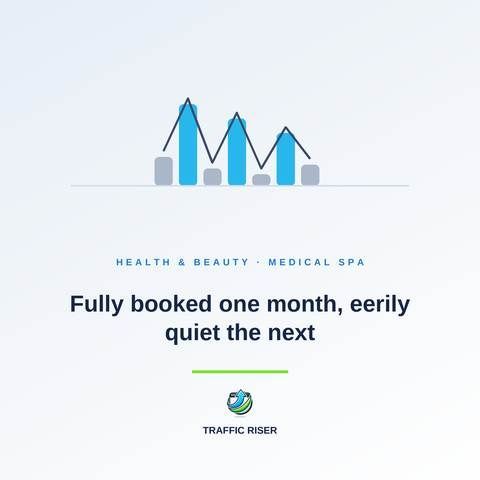
Bar chart showing a med spa fully booked one month and eerily quiet the next, illustrating unpredict
By Charlie Michaels • June 22, 2026
See how a med spa turned a feast-or-famine calendar into steady, predictable demand, then get your free 12-month growth plan with revenue projections today.
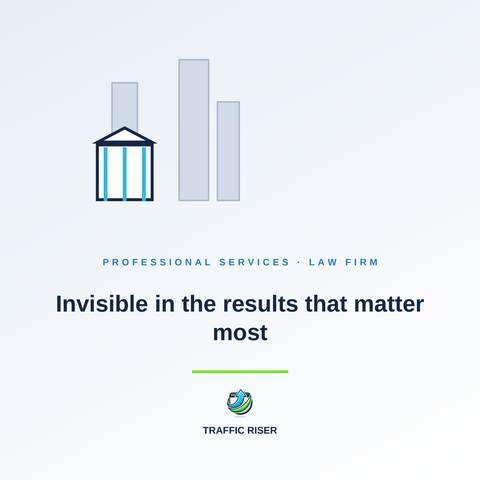
Bar chart illustrating a small law firm invisible in search results that matter most to potential cl
By Charlie Michaels • June 15, 2026
See how a small law firm fixed its local search visibility to compete with bigger firms, then get your own free 12-month growth plan with revenue projections today.
By Charlie Michaels • June 8, 2026
See how a 30-year family restaurant fixed its local search presence so new customers could finally find it, then get your own free 12-month growth plan today.
Show More